Table of Contents
Cats, Kids and Nutrition: How One Researcher Is Bridging the Gap Between Human and Animal Care
If you’ve ever found yourself comparing your cat’s diet label to your child’s breakfast cereal, you’re not alone. For many of us, feeding our pets is just as emotional – and sometimes confusing – as feeding our families. That’s exactly what Rachel Lumbis, a PhD candidate at the University of Glasgow, aims to understand in her groundbreaking cat nutrition research into how caregivers use, trust and accept nutritional information for both humans and animals.
Her cat and dog nutrition research explores how caregivers make feeding choices for both animals and young children, revealing what drives trust, preferences and decisions across species.
Her study, titled “An Evaluation of Cat, Dog and Child Caregivers’ Use, Trust and Acceptance of Nutritional Guidance and Information,” investigates how we make food choices for our dependents – and why we trust certain advice while ignoring others. It’s part of Rachel’s doctoral work in Veterinary Companion Animal Sciences within the School of Biodiversity, One Health and Veterinary Medicine.
Q&A with Researcher Rachel Lumbis
Q: What inspired you to explore how caregivers make nutrition choices for both their children and their pets?
Children and pets depend on caregivers for nutrition, meaning caregivers’ beliefs, habits, and priorities directly influence and shape their health and welfare. Identifying an appropriate diet is reportedly the most difficult aspect of caring for a pet and is also acknowledged as a challenge for child caregivers. Cross-species comparison of caregiving dietary decisions offers a unique way to understand human decision-making, offering insights into:
- family health dynamics and the cultural, socioeconomic, and psychological factors that shape feeding behavior and influence diet choice
- connections between human and animal well-being within the shared environment of the home
- caregivers’ prioritization of resources among dependents
- the influence of branding and health claims on purchasing decisions
Ultimately, it connects human and animal wellbeing and offers a holistic understanding of nutrition provision and care.
Rachel adds that by comparing caregiving behaviors across species, we can gain a holistic understanding of nutrition and care – how what we believe, buy and serve affects every member of the household, paws included.
Q: Your study examines ‘trust and acceptance’ of nutritional information – why is this so important?
The amount of nutrition-related information available to pet and child caregivers is extensive and varies in terms of quality and accuracy. Preferred nutrition information sources can potentially inform and misinform, influencing nutrition decisions and diet change and ultimately impacting human and animal health and welfare. Several factors can influence caregivers’ acceptance and rejection of nutrition information. Evidence suggests that use of nutrition information source does not necessarily correlate with the level of trust assigned to it. Understanding trust and acceptance of nutritional information is vital because these factors determine whether dietary advice is followed or ignored. It will further inform the approaches required for effective nutrition-related communication and education in veterinary and human healthcare.
In other words, your vet and your pediatrician may be saying the right things, but if TikTok is louder, that’s where many people listen first.
Q: Do caregivers feed their pets differently than their kids – or are there surprising similarities?
Provisional results confirm that caregivers often view both children and pets as family members, and feeding practices are strongly tied to care, affection, and guilt. I look forward to analysing the results of this study and discovering if and how caregivers apply similar principles to the feeding of their children, cats and dogs.
Q: What types of information sources do you expect participants to rely
on most: veterinarians, online groups, social media, or something else
entirely?
Recent evidence suggests that expert sources of information are the most trusted, yet non-expert sources are the most used. It will be interesting to see if the results of this study mirror these findings and to also compare the preferred information sources used by caregivers with respect to their pets versus their children.
Q: Many cat owners are drawn to homemade or “natural” diets, what’s your
view on this trend, and what should pet caregivers keep in mind before
trying it?
The wide range of available diet options, combined with the use of marketing strategies, health claims and unregulated terms such as ‘natural’, can make pet food selection challenging. Many caregivers find this the most difficult aspect of caring for a pet. Every pet is an individual and there is no single, best type of pet food, but caregivers (and their pets) may have their own unique views based on personal preferences and philosophies. Regardless of type, it is vital to ensure that a diet is appropriate for the pet and capable of meeting its nutritional needs. This includes consideration of several factors including:
- suitability for the pet’s age and life stage
- nutritional adequacy
- safety
- sustainability
- quality, quantity, proportions and digestibility of the ingredients
- quality control process
If a caregiver is unsure about the suitability of a particular diet, they should seek evidence-based guidance from a credible source and a suitably qualified person. Whilst many people pertain to be a ‘nutritionist’ or a nutrition expert, a true veterinary nutritionist is a veterinarian who has completed further education and earnt the post nominals DACVIM (Nutrition) and/or DECVCN. Respectively, these mean that the individual is board certified in veterinary nutrition by the American College of Veterinary Nutrition (ACVN®) and by the European College of Veterinary and Comparative Nutrition (ECVCN).
Rachel recommends checking credentials via:
American College of Veterinary Nutrition and European College of Veterinary and Comparative Nutrition.
Q: Social media often spreads conflicting nutrition advice. How do you
see this influencing both parental and pet feeding decisions?
Social media can encourage healthy, evidence-based feeding practices and act as a positive influence when caregivers engage with reputable content. Yet the amount of available nutrition-related information, available both on and offline, is extensive and varies in terms of quality and accuracy. Unfortunately, not everything posted on social media is from a credible source. Conflicting and misleading advice from self-proclaimed ‘experts’ can be easily spread and prove to be highly influential to caregivers, ultimately resulting in mistrust of credible information source and the feeding of suboptimal, and even dangerous, diet choices.
Several factors, including accessibility, trustworthiness, family dynamic and the human-animal bond, influence and affect caregivers’ preferred information source and information search behavior. When presented with information, even irrefutable evidence, people still gravitate towards sources most closely aligned with their own views and beliefs, even if these are inaccurate and misinformed, and refute any opposing ideas or theories. This emphasises the need for nutrition education, digital literacy and trust in credible information sources.
Q: What drew you to Veterinary Companion Animal Sciences and to this cross-species approach?
Irrespective of species, caregivers have a fundamental responsibility to provide balanced and appropriate nutrition, ensuring the growth, health, and well-being of their dependents. In the same way that pets are reliant on their caregivers for the provision of food, so are young children, and the effects of a suboptimal diet can have harmful consequences for both. Yet limited evidence exists to compare the feeding behaviors, beliefs and preferred information sources that influence pet and child caregivers’ dietary decision making. Through the completion of this project, we will:
- explore how caregivers choose food for their children and pets
- evaluate caregivers’ use, trust and acceptance of nutritional guidance and information.
Results of this research will help to:
- establish the relevance and importance that caregivers place on nutrition-related care, information and advice
- enhance our understanding of caregivers’ dietary decision making
- inform the approaches required for effective nutrition-related communication and education in veterinary and human healthcare.
Her results aim to support better nutrition education and evidence-based communication across both veterinary and human healthcare.
Q: Will you expand your research internationally or by culture?
“Potentially, yes,” Rachel says with a smile. “The cultural side of feeding – how different societies define ‘healthy’ or ‘natural’ – is incredibly intriguing.”
How You Can Participate
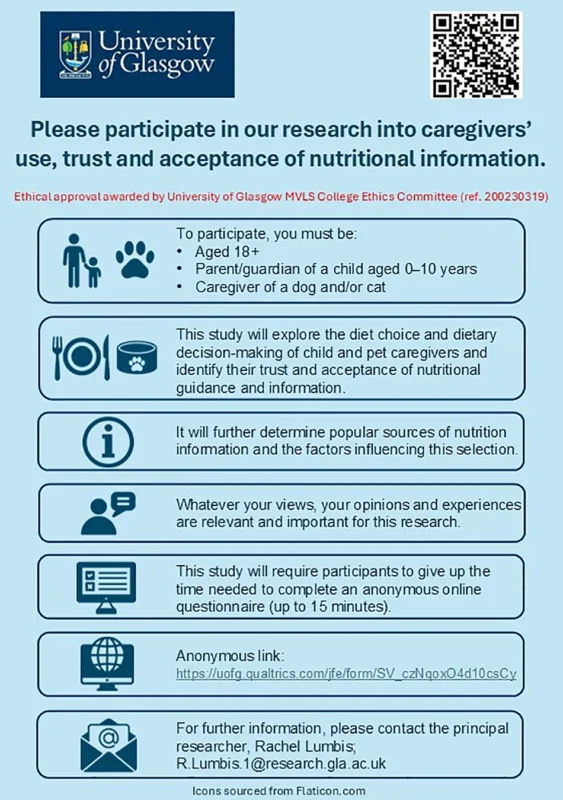
Rachel’s anonymous survey takes only about 15 minutes to complete and welcomes participants who are:
- 18 years or older
- A parent or guardian of a child aged 0–10 years
- A caregiver of a dog and/or cat
Take part here: University of Glasgow Caregivers’ Nutrition Study
Every honest answer contributes to better understanding between humans, animals, and the professionals who guide us. Your input could help shape future nutrition advice, improve pet food labeling, and strengthen trust between caregivers and experts.
So, if you’re a cat (or dog) lover who’s ever debated “grain-free vs. not,” or worried whether your child eats enough greens, this study is literally written for you.

Further information
Rachel Lumbis (she/her)
PhD Candidate, Veterinary Companion Animal Sciences
School of Biodiversity, One Health and Veterinary Medicine
College of Medical, Veterinary and Life Sciences, University of Glasgow
Email: R.Lumbis.1@research.gla.ac.uk
Lead academic supervisor: Dr Philippa Yam – Philippa.Yam@glasgow.ac.uk
Ethics approval: University of Glasgow MVLS College Ethics Committee (Ref. 200230319)
Funding: University of Glasgow Small Animal Hospital Fund (The Ronald Miller Foundation)